
Your Organization Is Already Telling a Story. Make It Strategic.
Most organizations tell a story about who they are—but few intentionally craft narratives showing how they'll survive uncertainty and thrive in a changing future. Yet that's exactly what today's complex, fast-moving world demands.
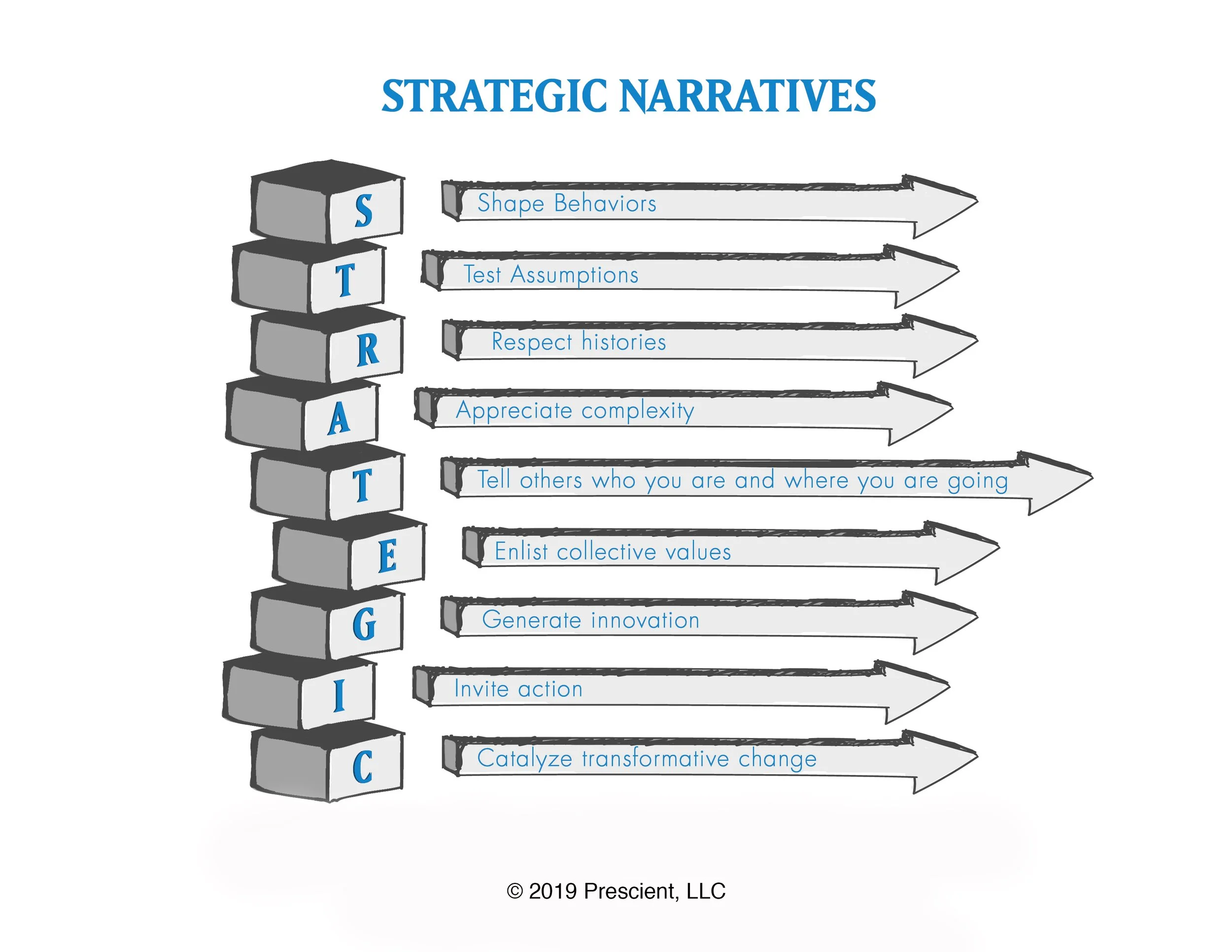
What is a strategic narrative?
An uncertain future, complexity, and an accelerating rate of change are the defining characteristics of our era. Yet most organizations approach their narrative assuming that the future is stable and knowable. Few intentionally create narratives demonstrating how they will survive periods of uncertainty and adapt and thrive in a different future.
To emerge intact, healthy, and strong, organizations today need a shared vision of who they are and an understanding of who they can become in the face of change. This is what a strategic narrative provides.
A strategic narrative is an intentionally composed, compelling and inspiring story that explains the enduring values shared by members of an organization, their origins as a collective, and what they want to achieve in the future—and how. But more than that: strong strategic narratives are the sinews that connect an organization's past with its vision of the desired future. A solid strategic narrative serves as an element of resilience. It radiates enduring meaning to its participants and model of transformative change, demonstrating new behaviors and interactions that will help the organization thrive.
What is strategic about a strategic narrative? What does it have to do with planning or strategy?
Great question.
All organizations have a story about where they come from, who they are and how they imagine the future. Part of that story is purposefully crafted (CEO speeches, the “our story” page on a corporate website). But much of it emerges organically—in the way people casually talk about the organization or create workarounds that end up embedded in the system. An organizational narrative’s conscious and unconscious elements are reinforced through people’s stories about their institutions and actions.
An organizational narrative becomes strategic when leaders get honest about the gap between their official story and the actual story people tell about the organization—in hallway conversations, exit interviews, Slack channels. A good strategic narrative closes that gap and offers new models for behavior using the actual story as its founding basis. Creating the conditions for new behavior and a new story opens pathways to future resilience.
What is so narrative about strategic narrative? Is it a story?
The short answer is yes. Although strategic narratives might not sound exactly like a novel or children’s book, strategic narratives are stories.
All humans understand our social reality through stories. We use spreadsheets to understand budgets, taxonomies to classify system elements, and stories to understand and influence each other.
As individuals, we tell stories about our experiences to make sense of what is happening around us, creating a constant dynamic thread that links past to present and future.
Organizational psychologists have empirically confirmed that the way we narrate our reality to ourselves plays an instrumental role in our behavior. Our stories become tools that guide our decision-making; people always seek to take steps that make sense based on what they did or what happened last. This behavior also shapes external reality. The adoption of gen AI in the workplace today is an outcome of individuals’ beliefs—their story—about its role in productivity and their own role in the mission at hand.
The link between narrative and external conditions offers critical insight for organizational leaders. Stories are ideal for introducing potential environmental changes and modeling new behaviors required to succeed in changing circumstances.
How can we create one single narrative that is also representative and inclusive?
This question is urgently essential. The answer starts with being honest about the decisive role of power in determining whose version of a narrative gets told. All groups have uneven power relations. This is not necessarily a bad thing. In families, parents rightfully have more power than their young children. In corporations, greater power ideally means more responsibility and accountability.
The uneven distribution of power suffuses institutional narratives. Some narratives are elevated to official status. In contrast, others are suppressed or unspoken. Recognizing this power imbalance is an essential element in the health of an organization and its successful management. Opening the organization to all of the stories that shape it is a critical strategic move, especially in a transparent, networked era in which many stakeholders drive organizational success.
Ultimately, this diversity is a form of strength, as companies that seek greater inclusivity recognize. To generate this strength, powerful strategic narratives must be elastic and inclusive enough to withstand the inevitable negotiations over their meaning by stakeholders.
This means creating narrative-building processes that actively surface suppressed voices and genuinely negotiate meaning with stakeholders—not just broadcasting a top-down story.
What is the outcome of a strategic narrative project? Are there tangible deliverables?
There are tangible and intangible deliverables. At the least, a project should produce an actual narrative: a story told in a style that is culturally aligned with the organization about its enduring values, how it began, its future vision and what it is doing today to achieve this vision.
If there is no compelling vision of the future in play, then strategic foresight work to create a viable aspirational vision is also recommended.
Strategic narratives are also frameworks for strategic communication. I instruct participants on using the narrative in a ‘recipe’ to communicate new initiatives consistently and compellingly for different audiences.
The intangible deliverables are as important. Executives or other participants in creating a strategic narrative develop a shared understanding of the company’s path and gain confidence in relating change to insiders and outsiders
How can we work together to create or revise our corporate strategic narrative? A case study:
Here is one case study from my own experience. A public resources company planned a significant transformation in its business model, beginning with the addition of a second core business. It was essential to convey the theme of continuity to shareholders and the public rather than radical change.
First, we uncovered the existing organizational narrative. I audited public statements, their website and other documents to clarify their intentionally communicated narrative about the company’s future. I conducted executive interviews to uncover their unconsciously held ideas about the future. In these interviews, I could observe the language patterns used to talk about the company. I held a series of interviews with company executives. They evoked past examples where they felt the company had succeeded and displayed its best values.
Based on that work, I supplied them with a set of seven enduring values they could refer to as touchstones to showcase the continuity and evolutionary aspects of their change. We also provided them a new strategic narrative that began in the past, pointed toward their intended future and rested on their actions today to evolve toward that future state. It helped persuade those leading change that they had an exciting, enduring quest to relate, rather than an abrupt change in their business model that might frighten investors.
Ready to clarify your organization’s narrative? Our working process
Here’s what the process looks like if we work together to create or revise your strategic narrative:
1. Uncover the narrative you're already telling We audit your official story—websites, leadership communications, public statements—and conduct stakeholder interviews to surface the unconscious narratives embedded in how people actually talk about your organization. This reveals the gap between the story you intend to tell and the story people are living.
2. Build a shared assessment of where you are From that work, we develop a picture of your present moment that stakeholders across the organization can recognize. This becomes your foundation.
3. Envision a future worth moving toward We explore emerging trends, assess your current long-term strategy against new conditions, and articulate an aspirational goal—something your organization can actually achieve.
4. Find the seeds of that future in your past Through stakeholder conversations, we locate moments when your organization already demonstrated the values and behaviors your future requires. They're already there.
5. Define what progress actually looks like We develop criteria and metrics so your organization knows which activities and actions move you toward your goal.
6. Create the communications strategy We develop collateral and a plan that demonstrates continuity and evolution—internally and externally. Your narrative becomes the frame through which people understand what's changing and why it matters.